



Recovery Is Complete Only When Normal Movement Returns
Recovery Is Complete Only When Normal Movement Returns
One of the greatest mistakes people make during recovery from back pain is believing that the disappearance of pain marks the end of the process. After weeks or months of discomfort, the first pain-free morning can feel like a finish line, and understandably so. You wake up, move around, and realize that the familiar sensation is no longer there. The temptation is immediate: to believe that everything is finally behind you and that your body is ready to return to the life you had before the pain began.
But pain is not the finish line. It is only one chapter in the recovery process.
True recovery involves much more than experiencing fewer symptoms. It means gradually restoring your body’s ability to move naturally, tolerate everyday demands, and respond to movement without unnecessary protection or hesitation. This is why one principle deserves to be remembered throughout the entire recovery journey:
Recovery is complete only when normal movement returns.
And reaching that point requires something many people find surprisingly difficult: the ability to put their ego aside.
When Confidence Returns Before Capacity
The moment pain becomes smaller, confidence often returns much faster than physical capacity. The mind begins to whisper that the problem is over: You’re fine now. Go back to training. Lift what you used to lift. You don’t need to be careful anymore.
The problem is that your tissues do not necessarily heal at the same speed as your confidence.
An irritated disc, an inflamed nerve, or overloaded spinal tissues may require time to recover their tolerance. That time is biological, not emotional. It cannot be shortened simply because you feel motivated, impatient, or eager to return to your previous routine.
This is one of the most difficult lessons in recovery: your motivation may be ready before your body is.
Modern life makes this even harder. We have become accustomed to speed in almost every aspect of our lives. Communication is instant, information is available immediately, and entertainment is delivered on demand. Without realizing it, we begin to expect the same efficiency from our bodies. We want discomfort to disappear quickly, and once it does, we expect our previous abilities to return just as quickly.
But biology has never followed the speed of technology.
Healing has its own rhythm, and respecting that rhythm is not a sign of weakness. It is part of understanding how recovery actually works.
Pain Is Feedback, Not an Enemy
Pain is not always a precise measurement of tissue damage, but it is important feedback about how your body is responding to movement, posture, load, and activity. It can tell you that a particular demand is currently exceeding your tolerance, or that your nervous system is still responding protectively to something it does not yet fully trust.
That feedback deserves attention.
A reduction in pain is encouraging, but it does not automatically mean that recovery is complete. It may mean that the process is progressing, while the tissues, movement patterns, and nervous system are still adapting.
This distinction matters because many setbacks begin at precisely this stage. Someone feels better, returns to the gym, resumes heavy lifting, or attempts explosive movements that their body has not yet regained the capacity to tolerate. Instead of gradually testing their recovery, they challenge it.
There is a meaningful difference between testing what your body can currently tolerate and demanding that your body perform at the level it used to.
The first approach creates information. The second can create a setback.
The Danger of Returning Too Quickly
Imagine someone who has spent weeks recovering from back pain and finally begins to feel normal again. They decide that the difficult period is over and return to a heavy deadlift, a demanding kettlebell session, or a Turkish get-up with a load they have not yet rebuilt the capacity to handle.
The intention may be understandable. They want to reclaim their strength, their routine, and perhaps a part of their identity that pain temporarily took away.
But the body does not respond to intention alone.
If the demand exceeds current tolerance, symptoms may return. Sometimes they return in a familiar way. Sometimes the experience is different, more diffuse, or more difficult to interpret. A movement that previously felt comfortable may suddenly become provocative, while other movements that were never a problem begin to cause discomfort.
This does not necessarily mean that something catastrophic has happened, but it does mean that the body is providing new information that should not be ignored. The appropriate response is not panic, and it is not to push harder to prove that you are fine. It is to reassess the demand, adjust the approach, and allow recovery to continue.
The goal is not to prove that you are strong. The goal is to rebuild the capacity to move well.
Strength can wait. Biology cannot.
Patience Is Clinical Intelligence
Patience is often misunderstood as doing nothing, avoiding movement, or accepting limitations indefinitely. That is not what meaningful recovery requires.
Good recovery is not passive. It is a process of gradually restoring movement, capacity, confidence, and tolerance through appropriate progression. It requires paying attention to how your body responds, understanding that progress is not always linear, and resisting the urge to turn every improvement into a reason to accelerate.
In that sense, patience is not simply a personality trait. It is a practical skill.
It means recognizing that a good day is not necessarily permission to abandon the process. It means understanding that a temporary increase in symptoms does not automatically mean failure. And it means learning to distinguish between productive challenge and unnecessary provocation.
Your body needs time not only to recover physically, but also to regain confidence in movement. When pain has been present for a long time, the nervous system may become more protective, and movements that were once automatic can begin to feel threatening or uncertain. Restoring normal movement therefore involves more than reducing symptoms. It involves rebuilding trust.
What Does Complete Recovery Actually Look Like?
Recovery should not be measured by a single moment, a single pain score, or one reassuring morning. It is better understood as the gradual return of function.
Can you walk without constantly monitoring your back? Can you bend without fear? Can you change positions naturally? Can you perform everyday tasks without feeling that every movement requires a defensive strategy? Can you gradually return to activities you value without repeatedly provoking symptoms?
These questions are often more meaningful than simply asking whether the pain has disappeared.
Even medical imaging, when appropriate, is only one part of the picture. Changes visible on an MRI do not always correspond directly to pain or function, and a scan alone cannot tell you whether you have regained normal movement capacity. Recovery is a clinical and functional process, not merely a visual one.
The real objective is not to live in permanent fear of movement. It is to reach a point where movement becomes ordinary again.
Not something you constantly analyze.
Not something you approach with hesitation.
Not something your body feels compelled to protect itself from.
But something you can trust.
The Return of Freedom
This is why I believe the following principle is worth carrying with you throughout recovery:
Recovery is complete only when normal movement returns.
Not simply when pain becomes smaller. Not when your motivation tells you that you are ready. Not when you feel the need to prove that you have returned to your old self.
Recovery becomes meaningful when your body can once again move with freedom, confidence, and an appropriate level of tolerance.
Freedom to walk without thinking about every step.
Freedom to bend without fear.
Freedom to change positions naturally.
Freedom to gradually lift, train, and participate in the activities that matter to you.
And perhaps most importantly, freedom to trust your own body again.
That is the direction recovery should take: not merely away from pain, but toward a life in which movement is no longer something you have to negotiate with every day.
A Structured Way to Begin
If you are currently recovering from back pain, the next step should not be to rush toward the most demanding exercise you can perform. It should be to establish a structured, progressive approach that helps you understand your current tolerance and gradually rebuild your movement capacity.
That is the purpose of the Spinalyx 28 Days Recovery Program.
The program is designed to guide you through a structured recovery process, combining education, progressive movement, and practical steps that help you move from simply managing symptoms toward rebuilding confidence and function.
Because recovery is not about winning a battle against your body.
It is about learning how to work with it.
And the goal is not to return to movement as quickly as possible.
The goal is to return to movement in a way that lasts.
Explore the Spinalyx 21 Days Recovery Program and take the next step toward rebuilding your movement, confidence, and freedom.

Sciatica Is Not Your Enemy. It Is Your Greatest Teacher.
When sciatica appears, it can feel as if your body has suddenly turned against you. Sciatica pain can interrupt
sleep, work, movement, training, and even simple daily activities. It is natural to want it gone as quickly as
possible.
But there may be a more useful way to look at what is happening.
Sciatica is not something to hate or fight blindly. Pain is a signal that deserves attention. It does not always tell
you exactly what the problem is, and it does not mean that your body is damaged beyond repair. But it can be an
invitation to stop, pay attention, and understand what your body needs.
For many people, that change in perspective is where recovery begins.
What Sciatica Pain May Be Telling You
Sciatica describes pain and other symptoms that can occur when the sciatic nerve or one of the nerve roots
connected to it becomes irritated or compressed.
The experience is different for everyone. Some people feel sharp or burning pain. Others notice tingling,
numbness, weakness, or discomfort that travels from the lower back or buttock into the leg.
There is also no single reason why sciatica develops. A disc problem, spinal narrowing, an injury, or another
source of nerve irritation may be involved. Symptoms may build gradually, but they can also appear suddenly.
That is why sciatica pain should be treated as information, not as a complete diagnosis. Instead of
asking only, “How do I make this pain disappear?”, it can be more useful to ask:
“What is contributing to this, and what does my body need from me now?”
That question changes the way you approach recovery.
Pain Is a Signal, Not an Enemy
Most of us react to pain in one of two ways: we ignore it or we try to eliminate it as quickly as possible.
We continue sitting, lifting, training, working, and pushing until the discomfort becomes difficult to ignore. Then
we search for the fastest possible solution: a different chair, a new mattress, another exercise, another
treatment, or something that promises immediate relief.
Some of those things may help. But lasting progress usually requires something more important:
understanding the individual problem in front of you.
Pain is a messenger. It can tell you that something needs attention, but the message still has to be interpreted
correctly.
For one person, certain movements or loads may aggravate symptoms. For another, too much inactivity
may be part of the problem. Daily habits, physical capacity, previous injuries, sleep, recovery, and the
demands placed on the body can all matter differently from one person to another.
The goal is not to become afraid of every sensation.
The goal is to become better at listening to your body and responding appropriately.

Recovery Starts With Understanding
Your body is not a machine with one faulty part that simply needs to be replaced. It is a living system that
continuously adapts to the demands placed on it.
That is why recovery should not be reduced to chasing pain from one day to the next.
It should begin with understanding what may be irritating your symptoms, what your body can currently
tolerate, and how that capacity can gradually be rebuilt.
Depending on the individual, that process may involve adjusting certain activities, changing the way you move,
improving strength and control, and allowing the body enough time to adapt.
There is no universal solution that works exactly the same way for everyone.
This is also why copying someone else’s exercise routine from the internet is not always the answer. Two people
can both say they have sciatica while experiencing different symptoms, different causes, and very different
physical demands in everyday life.
So instead of asking only:
“What is the best exercise for sciatica?”
A better question may be:
“What is appropriate for my body, my symptoms, and my current capacity?”
Listen Before Your Body Has to Speak Louder
One of the most valuable lessons pain can teach is awareness.
When life becomes busy, it is easy to place work, deadlines, responsibilities, and other people’s
expectations ahead of your own physical well-being.
Stiffness, fatigue, reduced tolerance for certain activities, or recurring discomfort can become things we simply
learn to live with.
That does not mean every episode of sciatica was preventable. It also does not mean that you caused your
own pain because you failed to listen to your body.
Sciatica has many possible causes, and symptoms can sometimes appear without a long period of warning.
However, recovery can still become an opportunity to build a different relationship with your body.
Notice what tends to increase your symptoms and what helps settle them. Respect recovery instead of treating it
as lost time. Learn the difference between gradually building capacity and constantly testing your limits.
Most importantly, do not allow pain to convince you that movement itself is the enemy. The goal is
not to move less because you are afraid.
The goal is to move with more understanding.
Recovery Is More Than Removing Pain
Reducing pain matters. When sciatica pain is intense, relief may be the only thing you can think about.
But successful recovery should eventually become about more than simply having a pain-free day. Successful recovery means rebuilding confidence in movement. It also means returning to the activities that matter to you without constantly wondering whether your back will “go” again. At the same time, recovery involves understanding your current limits while patiently expanding what your body is capable of doing.
In that sense, sciatica can become a teacher.
Not because pain is good.
Not because you should be grateful for suffering.
And not because every painful experience contains some hidden lesson.
But because a difficult period can force you to pay attention to something that was previously easy to overlook:
the relationship you have with your own body.
When Sciatica Symptoms Need Medical Attention
Listening to your body also means recognizing when symptoms should not simply be ignored or pushed
through.
New or worsening muscle weakness, loss of bladder or bowel control, or numbness around the groin or saddle
area can be signs of a more serious neurological problem and require urgent medical assessment.
Symptoms that continue to worsen or significantly interfere with normal daily activities should also be evaluated
by an appropriate healthcare professional.
Understanding what you are actually dealing with should come before trying to force your way through it.

A Different Way to See Sciatica
Sciatica does not have to become an enemy that controls your decisions.
Instead, it can become a signal to slow down long enough to understand what is happening, stop chasing
random solutions, and begin rebuilding trust in your body with an approach that makes sense for you.Your spine deserves attention before fear takes over. Give your nervous system patience and treat your body with care, not punishment.
Recovery is not simply the moment pain disappears. It is the process of becoming more aware, more capable, and
more confident in how you move and live.
Sciatica is not your enemy.
Perhaps its greatest lesson is not only how to recover from pain, but how to start listening to your body before
it has to demand your attention.

MRI for Back Pain: Why the Scan Isn't Your Sentence
Your MRI Is Not Your Sentence: What Viktor Frankl Understood About Back Pain
“When we are no longer able to change a situation, we are challenged to change ourselves.”
Frankl wrote that about surviving conditions no one would choose. But the principle reaches further than the circumstances that produced it — including into something as ordinary as a sore back, or as unsettling as an MRI for back pain report full of words you don’t recognize.
Because here is what most people are never told: when you cannot change the structure of your spine, you can still change how your body lives with it.
The Two Scans That Don't Make Sense
Imagine two people.
The first has a clear MRI. Clean discs, no degeneration, nothing a radiologist would circle. And yet some mornings they can barely get out of bed.
The second has a disc herniation visible on the scan, the kind of image that looks alarming on a screen. And yet they move through their day without a second thought.

This isn’t a rare exception. It’s one of the most consistent and uncomfortable findings in MRI for back pain research: what shows up on an image and what a person actually feels often don’t line up. Studies that scan people without any back pain routinely find disc bulges, degeneration, and protrusions in a large share of them. The damage is there. The pain isn’t.
Research from spine biomechanics labs, including the work behind the methods we build our programs on, developed at Dr. Stuart McGill’s laboratory at the University of Waterloo, points to the same conclusion from the other direction: how you load and move your spine throughout the day often matters more for how it feels than what a single snapshot shows.
Why the Picture Isn't the Whole Story
An MRI for back pain is a photograph. It captures one frozen moment of anatomy.
But your spine isn’t a photograph; it’s something you use thousands of times a day. Every time you bend, lift, twist, sit, and stand, you’re either loading it in a way it tolerates well, or in a way it doesn’t.
That daily pattern of movement is not fixed. The image might be. The behaviour around it isn’t.
This is the quiet shift that changes everything: you may not be able to negotiate with the scan, but you can change the strategy your body uses around it.
What Your MRI for Back Pain Really Means
If you’ve been handed an MRI for back pain report full of words like protrusion, degeneration, or desiccation, it’s easy to read it as a verdict — proof that your back is broken and the rest of your life will be spent managing the damage.
It isn’t a verdict. It’s information about the structure. And structure is only one part of the equation.
The part you can work on is function: how you move, how you build tolerance, how you stop loading your spine in ways that provoke it, and how you start loading it in ways it can handle.
That work doesn’t erase what’s on the scan. It changes what the scan means for your daily life.
Frankl’s line was never about pretending the situation is fine. It’s about identifying what you can still influence when part of the picture is fixed.
Your spine may have limits you didn’t choose. What you do with it, most days, is still yours.

Where to Start
Changing how your spine handles daily life doesn’t begin with a grand plan. It begins with a few movements done consistently.
We put together five simple movements you can begin today, the same foundational patterns we use at the start of our programs to help the body build tolerance and move with more confidence.
No equipment. No gym. Just a starting point.
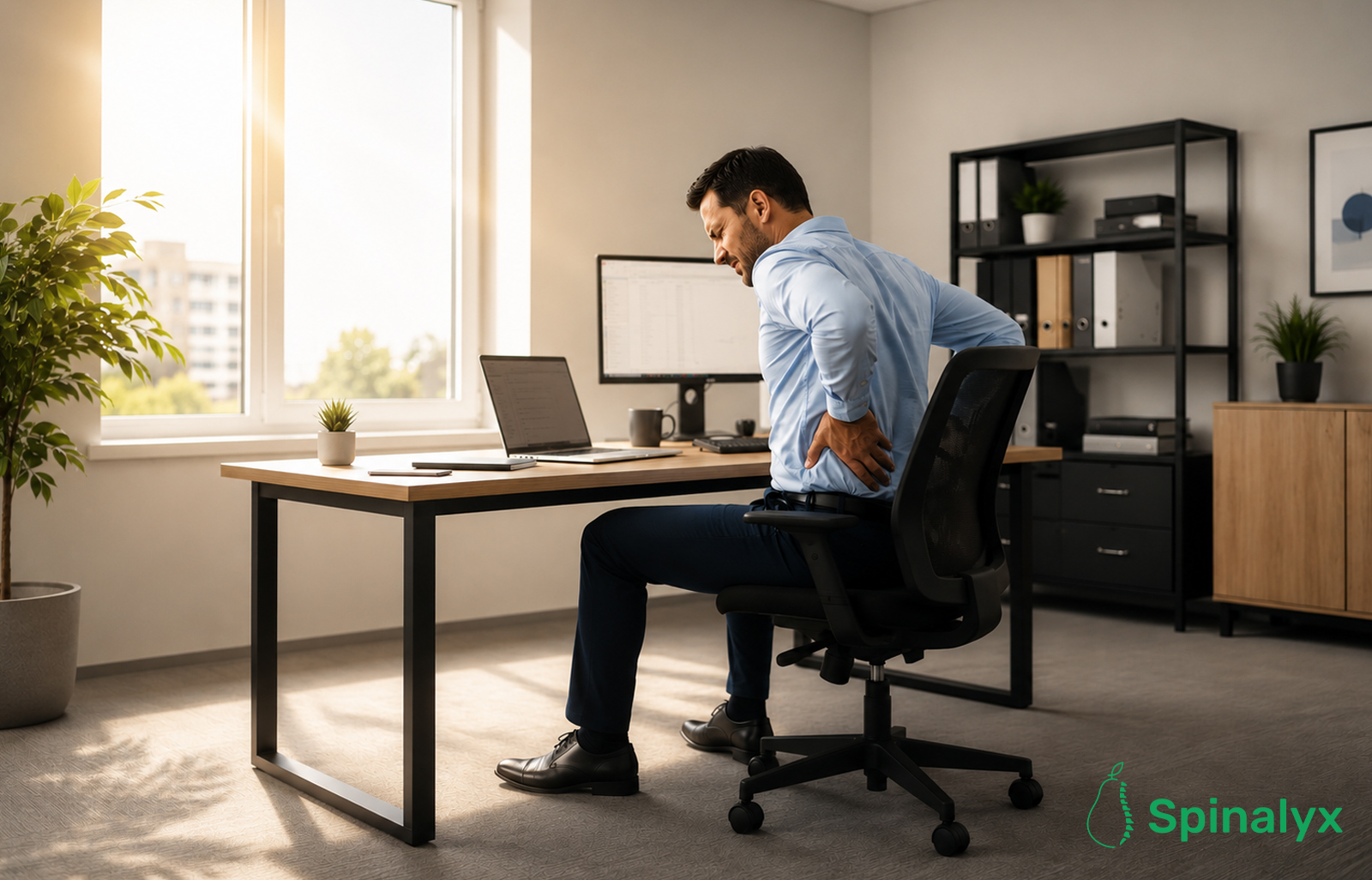
Back Pain From Sitting All Day Spinalyx Program
Why Your Desk Job Is Destroying Your Back, And What a Structured Back Pain Program Can Do About It
You notice it around 2pm. A dull ache in your lower back. Tightness across the shoulders. Maybe a heaviness in your legs that wasn’t there when you sat down this morning.
If this sounds familiar, you are not alone, and more importantly, you are not broken.
Low back pain from sitting all day is one of the most common conditions affecting working adults globally. Research consistently shows that prolonged, unbroken sitting compresses the lumbar discs, shortens the hip flexors, and progressively disengages the deep back stabilizers of your spine. Over weeks, months, and years, this accumulates. The pain you feel at your desk is not random. It has a clear mechanical cause, and a clear, structured solution established long time ago.
The Problem With "Just Stretching More"
Most people dealing with back pain from a desk job try the same things: a new chair, a standing desk, a few YouTube stretches during lunch. Some of these help briefly. None of them address the underlying dysfunction.
Office back pain relief requires more than isolated stretches. It requires a structured approach that addresses how you load your spine, how you move throughout the day, and how you rebuild the stability of your sedentary routine has eroded. Without that structure, the pain returns, every single time.
What an Effective Back Pain Exercise Program Actually Looks Like
First: understanding load. Not all movements are equal. Certain exercises that look harmless - aggressive forward bends, unsupported twists, high-load sit-ups - actively aggravate a sensitized spine. A well-designed back pain exercise plan begins by identifying what your spine can safely tolerate today, and builds from there.
Second: movement retraining. Prolonged sitting creates predictable patterns: overactive hip flexors, inhibited glutes, reduced compressive tissue tolerance. Exercises for desk back pain that specifically target these patterns - hip hinges, glute activation, thoracic extension - begin to reverse the structural consequences of your workday within weeks.
Third: progressive loading. Recovery is not static. A structured back pain program moves you through phases, from pain management and basic stability, through functional movement, and ultimately back to the activities you've been avoiding. Whether your goal is returning to the gym, getting back to sport, or simply making it through a workday without discomfort, the program should evolve with you.
Why an Online Back Pain Program Works
The most effective posture correction program online is the one you can actually do consistently – from your home office, your living room, or a hotel room on a business trip. Accessibility is not a compromise. For most desk workers dealing with back pain working from home, an online workout for back pain delivered by qualified specialists is more practical, more sustainable, and equally effective as in-person physiotherapy when built on the right clinical foundations.
The Path Forward
Fixing back pain from a desk job without disrupting your life is not a fantasy. It is the outcome of a structured, clinical evidence-based approach applied consistently over time.
The spine responds to intelligent movement. It does not respond to rest, avoidance, or hope.
If you have been waiting for the pain to go away on its own, it is time to stop waiting.
Move Free. Live Fully.
Explore the Spinalyx back pain relief course at spinalyx.thinkific.com. A structured, expert-led, and built for people who sit for a living.